


Why Does My Toddler Talk to Himself? The Psychology of Private Speech
“One minute your toddler is quietly playing with a puzzle. The next, they are giving themselves instructions, arguing with an imaginary person, announcing that the block ‘goes here,’ and somehow providing a full commentary on the situation.”
For many parents, hearing a toddler talk to themselves can be confusing. You might wonder whether they are simply playing, practising language, imagining a conversation, or trying to tell you something.
In most cases, talking to themselves is a normal and useful part of early childhood development.
Psychologists often call this private speech or self-directed speech: speech that children use to guide themselves rather than communicate directly with another person. Research suggests that it can help young children organise their thoughts, manage frustration, solve problems and regulate their behaviour.
So when your toddler says, “No, no, put it here… now turn it… I can do it!”, they may not be talking nonsense.
They may actually be thinking out loud.
What Exactly Is Private Speech?
Private speech is language directed towards oneself rather than another person.
It can sound like:
“Where's my red car?”
“First this one, then this one.”
“Don't touch it.”
“I can't do it… try again.”
“Come on, shoe. Go on!”
It can even involve a child narrating an entire activity as though they are both the actor and the commentator.
Researchers distinguish this from ordinary social speech because the child is using language primarily to organise their own thoughts or behaviour.
And yes, sometimes the toddler will also provide commentary on absolutely everything happening in the room.
That part is free.

Why Do Toddlers Do It?
The simplest explanation is:
Language helps children think.
Adults often think silently.
A toddler's thinking is still developing, so saying something aloud can help them organise what they are doing.
Imagine a child trying to complete a difficult puzzle.
They might say:
“This one doesn't go here.”
Then:
“Turn it.”
Then:
“No, wrong.”
Then:
“Here!”
The child is using speech to guide their actions.
Research on three-year-olds has found that mature, task-related private speech is associated with better inhibitory control, suggesting that this kind of self-talk may play a role in the development of self-regulation.
From Talking Out Loud to Thinking Quietly
One of the most interesting ideas in developmental psychology comes from psychologist Lev Vygotsky.
Vygotsky proposed that children's external speech gradually becomes internalised.
In simple terms:
Talking with other people → talking to yourself → thinking silently
A child may first learn how to solve a problem because an adult talks them through it.
Eventually, the child starts saying those instructions themselves.
Later, the instructions can become internal thoughts.
So when a toddler says:
“Don't touch. It's hot.”
they may eventually be able to think:
“Don't touch that.”
without saying it aloud.
Private speech can therefore be understood as part of the development of what we eventually experience as inner speech.
“First This, Then That”: Self-Talk Helps With Problem-Solving
Watch a toddler trying to put on their shoes.
You might hear:
“Sock first.”
“No, this one.”
“Foot in.”
“Where's the shoe?”
“Now this.”
It may sound like a tiny personal podcast.
But the child is breaking a complicated task into smaller steps.
Private speech can help children:
Plan what to do.
Remember instructions.
Focus attention.
Work through difficult tasks.
Correct mistakes.
Keep themselves motivated.
Manage frustration.
Researchers have described this as an important part of children's developing self-regulation.
Talking to Themselves Can Help With Big Feelings Too
Toddlers are still learning how to manage emotions.
A two-year-old does not necessarily have the ability to think:
“I am becoming frustrated, so I should take a moment to calm myself down.”
That kind of emotional regulation takes time to develop.
Instead, they might say:
“I'm angry!”
“Don't cry.”
“It's okay.”
“Try again.”
The words themselves can become a way of organising the emotion.
Research following children from age 3 found that the maturity of their private speech during a challenging task was associated with inhibitory control at age 4 and, indirectly, with later emotion regulation. The relationship was particularly noticeable among children who were more prone to anger and frustration.
This does not mean that every child who talks to themselves will automatically develop better emotional regulation.
But it does suggest that private speech can be one tool children use while those abilities are developing.
“I'm Going to Do It!”
Private speech can also provide motivation.
Think about the difference between:
“I can't do it.”
and:
“I can't do it… try again.”
The second sentence contains a tiny self-coaching strategy.
Children may encourage themselves while attempting something difficult:
“Come on.”
“You can do it.”
“Try this one.”
“Almost!”
They are learning not only how to complete the task, but how to keep themselves going when the task becomes frustrating.
Is All Self-Talk the Same?
Not necessarily.
Researchers distinguish between mature, task-related private speech and speech that is less connected to the child's activity.
Mature private speech might sound like:
“This piece goes here.”
or:
“I need the big one.”
It directly relates to the child's goal.
Less mature forms can include repeated sounds, phrases or speech that has little connection to what the child is doing.
This distinction matters because simply counting how much a child talks to themselves does not tell us everything.
What they are saying matters too.
What About Imaginary Conversations?
This is another reason toddlers may appear to be talking to themselves.
A child might have a conversation with:
A stuffed animal.
An imaginary friend.
A toy.
A character from a story.
An imaginary version of Mum or Dad.
A completely invented person whose backstory apparently requires several seasons.
This can be part of pretend play.
Pretend play gives children opportunities to practise language, social roles, problem-solving and emotional experiences.
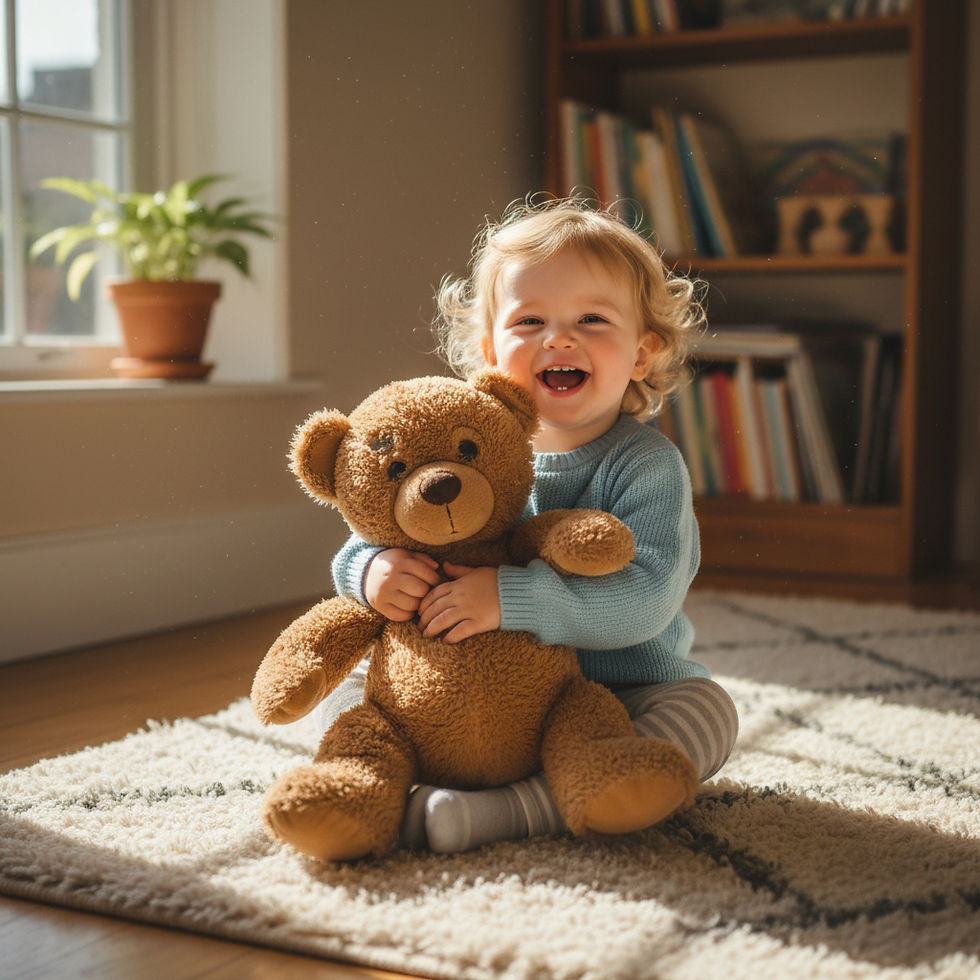
So when your toddler sits beside a teddy bear and says:
“No, Teddy. You can't have that. Say sorry.”
they may be experimenting with the same social rules that adults use with them.
They are not necessarily confused about whether Teddy is actually a person.
They may simply be playing with the idea of relationships.
Sometimes Children Rehearse Conversations
Have you ever heard your toddler repeat something you said earlier?
“No jumping on the sofa.”
Then, five minutes later:
“No jumping, Teddy!”
Children often reproduce phrases they hear from adults.
This can be part of language development and social learning.
They may be practising:
New vocabulary.
Sentence structures.
Emotional expressions.
Social rules.
Instructions.
Conversations.
This is one reason everyday conversations with children matter so much.
They are not simply listening.
They may later rehearse what they heard through their own speech.
Parents Can Actually Encourage Healthy Private Speech
You do not need to sit your child down and announce:
“Today we are beginning our private-speech development programme.”
Thankfully.
Instead, you can naturally model self-talk.
For example, while doing something together, say:
“Hmm, this doesn't fit. I'm going to turn it around.”
Or:
“I'm getting frustrated, so I'm going to take a breath and try again.”
Or:
“First we put the toys away, then we read the book.”
This gives children examples of how language can be used to organise behaviour and emotions.
Don't Interrupt Every Conversation
When toddlers talk to themselves, adults sometimes feel the need to respond to everything.
But if your child is happily working through a puzzle while saying:
“This one… no… this one… yes!”
you do not necessarily need to jump in.
Give them space to solve the problem.
Children's private speech is partly useful because they are doing the regulating themselves.
Research has also found that parenting can influence children's use of task-related private speech. One longitudinal study found that when mothers were highly sensitive but less directive during toddlerhood, their children showed more facilitative, task-related private speech during later preschool tasks.
In other words:
Support does not always mean taking over.
Sometimes it means giving your child enough space to try.
But Don't Leave Them Struggling Forever
There is a difference between allowing independence and refusing to help.
If your toddler says:
“I can't do it!”
you could respond:
“You sound frustrated. Do you want to try once more, or should I help you?”
This gives them both options:
independence and support.
The goal is not for children to solve everything alone.
It is for them to gradually develop the tools to handle manageable challenges themselves.
Private Speech and Language Development
Private speech also sits at the intersection of language and self-regulation.
Language gives children a way to represent what they are thinking and feeling.
For example:
“I'm angry.”
is more useful for self-regulation than simply screaming.
Similarly:
“I need help.”
allows a child to communicate a need instead of immediately throwing the toy.
Research reviewing the relationship between language and self-regulation suggests that language can help children organise and represent internal states and regulate their own behaviour.
This is one reason parents should take children's words seriously, even when those words seem messy or incomplete.
What If My Toddler Talks to Themselves All the Time?
Frequency alone is not necessarily a reason for concern.
Some children simply talk more than others.
Instead of counting how often your child talks to themselves, look at the bigger picture.
Ask:
Is my child otherwise communicating appropriately?
Do they interact with other people?
Do they understand and respond to simple communication?
Can they engage in play?
Does their speech generally relate to what they are doing?
Are they developing other skills over time?
Private speech itself is a normal developmental phenomenon, particularly during the preschool years. Research has found developmental changes in private speech across the preschool period, including increasing internalisation over time.
When Should Parents Talk to a Professional?
Talking to oneself is not, by itself, a sign that something is wrong.
However, if you are concerned about your child's overall communication or development, it is reasonable to discuss those concerns with a paediatrician, child-development specialist or speech-language professional.
Pay particular attention to the broader pattern rather than one behaviour.
For example, concerns may be more significant if a child has persistent difficulties with communication, understanding language, social interaction or everyday functioning.
Research on self-directed speech in children with neurodevelopmental conditions shows that its development and use can differ across conditions such as ADHD, autism and developmental language disorder. However, this does not mean that talking to oneself is evidence of any of these conditions.
A single behaviour should never be used to diagnose a child.

The Wonderful Thing About “Thinking Out Loud”
The next time you hear your toddler having a conversation with absolutely nobody, listen for a moment.
Maybe they are saying:
“First the blue block.”
Maybe:
“No, don't fall.”
Maybe:
“I'm angry. I need Mum.”
Maybe they are explaining an extremely complicated situation to a teddy bear who, frankly, seems underqualified to help.
Whatever the conversation, your child may be doing something remarkably important:
learning how to use language to guide their own mind and behaviour.
They are practising planning.
They are practising problem-solving.
They are practising emotional regulation.
And, little by little, the words they say aloud today may become the thoughts they can use independently tomorrow.
So the next time your toddler starts talking to themselves, don't immediately interrupt the conversation. They might just be learning how to become their own little coach, and apparently, the coaching session is already underway.
Disclaimer: This content is for educational purposes only and should not replace professional advice.
Shop authentic baby products online at Nexbie Store – trusted quality for your little one.
Visit www.nexbie.in today


Comments